

posted 24th August 2026
At three o’clock in the morning, a data centre is still consuming power, shedding heat, watching alarms, controlling access and serving customers who expect it to stay available. The building may look quiet from the road. Inside, quiet is something people work hard to maintain.
South Wales is preparing for much more of this work. The AI Growth Zone announced for the M4 corridor from Newport to Bridgend carries £10 billion of planned investment and an estimate of at least 5,000 jobs over a decade, covering construction, operation and AI research. Vantage Data Centres has also announced plans that include the former Ford engine plant at Bridgend.
The decade-long timescale deserves attention. The people pouring concrete, installing electrical systems and commissioning cooling plant will not all become the people operating the site. Some will. Many will move to the next build. The permanent team has a different job: learning the facility well enough to spot a weak signal before it becomes an outage.
For employers, colleges and candidates, “data centre jobs” is too loose a category to plan around. The work changes as the site changes. Here is a closer look at the people involved.
Three teams can pass through the same plant room
Imagine the same electrical room at three points in its life.
During the build, it is an installation environment. Contractors are working from drawings, equipment is arriving, routes are being completed and systems are still taking shape.
During commissioning, every component must prove that it behaves as intended; individually, as part of a system and under failure scenarios. Records, test results, defects and handovers begin to matter as much as physical progress.
Once operational, the room belongs to a team that may live with it for years. They carry out rounds, respond to alarms, control maintenance, manage vendors and keep a precise account of change. The engineer on shift needs to know what normal sounds, smells and looks like in that particular facility.
Those three encounters may involve similar technical foundations. The responsibilities, pace and evidence are different.
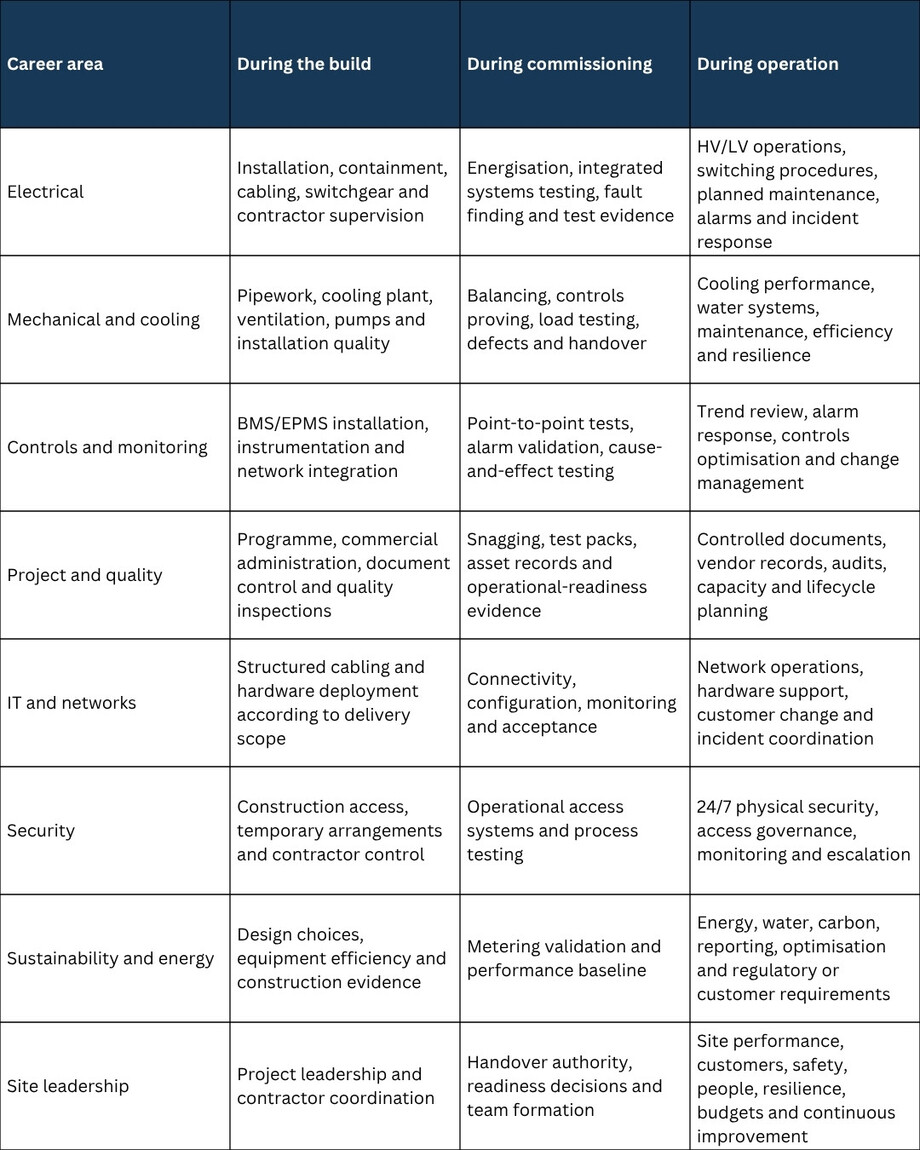
How to use this map: It describes common role families across the data-centre lifecycle. Individual operators organise work differently, and the South Wales investment announcement should not be read as a list of vacancies available today.
The build creates visibility. Operations creates continuity.
Construction activity is easier to see. Cranes arrive, contractor numbers rise and traffic around the site changes. The operating workforce is smaller and more permanent, spread across shifts, vendors and specialist functions.
A project can recruit heavily during construction and still approach handover without enough people who understand how the finished site will run. The risk often appears late because the building seems close to completion. Operational knowledge takes time to develop. New hires need site-specific procedures, systems training, authorised-person pathways, vendor relationships and familiarity with the escalation chain.
Hiring that team a few weeks before handover leaves little room for a difficult search, notice periods or a candidate who needs a carefully supervised move from another sector.
The sensible point to start depends on the role, but critical facilities and site leadership can carry long lead times. Employers should work backwards from the date when the person must begin learning the asset, not from the date when the rota first needs covering.
The facilities team: people who notice small changes
Many data-centre careers sit closer to engineering than software. A critical-facilities team may cover electrical distribution, generators, UPS systems, cooling, pumps, controls, fire systems and the routines that keep maintenance safe.
The strongest engineers are not necessarily the people who have already held the exact job title. Employers often value evidence that somebody can work around high-consequence systems, follow procedures, communicate during an incident and resist the urge to improvise when a controlled response is required.
That opens realistic routes from:
- Industrial electrical and mechanical maintenance;
- Power generation and distribution;
- Utilities and water treatment;
- Process manufacturing;
- Pharmaceutical or food production;
- Rail, defence and other safety-led environments;
- Building services and facilities management;
- Maritime, aviation or military engineering.
The route is not automatic. Equipment knowledge, authorisations, switching experience, cooling technology, controls, shift work and operational discipline all need to be checked. A maintenance engineer who has spent years in a production plant may bring excellent diagnostic judgement while still needing structured training on data-centre topology and site procedures.
That is a much better recruitment conversation than asking whether somebody has “five years’ data-centre experience” and rejecting everybody who has not.
Commissioning is where two labour markets meet
Commissioning sits between construction and operation, which makes it one of the most useful places to look for future operating talent.
People working through energisation, testing, controls validation and integrated systems tests see how the asset was intended to behave. They also see defects, workarounds and the practical differences between drawings and installed reality. Some will prefer project life and continue from site to site. Others may want the continuity of an operating role.
An employer hoping to retain that knowledge needs an honest proposition. Permanent operations usually means shifts, procedures, repeatable maintenance and responsibility for a single environment. Commissioning may offer travel, variety and bursts of intense project work. Pay alone will not decide the move.
Conversations held during commissioning can reveal who enjoys fault finding, who records evidence properly, who communicates calmly and who is genuinely interested in owning the site after handover. Waiting until the contractors leave discards that opportunity.
“AI jobs” and data-centre jobs live in different parts of the building
Public announcements understandably connect data centres with artificial intelligence. Candidates may then search for “AI jobs” and expect software, research or data-science roles.
Some of those careers may develop around the wider Growth Zone. The physical data centre also needs people who manage power, cooling, connectivity, security, hardware, capacity and customers. A site can employ excellent facilities engineers who never train an AI model, and brilliant AI researchers who never enter a plant room.
Colleges, careers advisers and employers will need more precise language if local people are to prepare for the opportunities. “Digital skills” does not tell an apprentice electrician about critical power. “Green skills” does not explain cooling efficiency. “AI training” does not prepare somebody to perform controlled switching at 3am.
Young people should be able to see the full range: technical operations, engineering, IT infrastructure, security, sustainability, project controls, commercial work and research. Many of these routes begin with qualifications and experience Wales already understands.
The jobs announcement covers a decade. Candidates plan in months.
A ten-year investment horizon is useful for policy and education. Somebody considering a career move needs to know what can be done this year.
Candidates can begin by gathering better evidence of their existing work:
- Systems and equipment maintained;
- Voltage levels or mechanical plant encountered;
- Permits, authorisations and safe systems of work;
- Planned and reactive maintenance responsibilities;
- Examples of diagnosis under time pressure;
- Controls, BMS, SCADA or monitoring exposure;
- Shift, call-out or 24/7 operational experience;
- Vendor supervision and handover work;
- Safety, quality and incident records;
- Improvements to energy, reliability or maintenance performance.
A CV saying “responsible for maintenance” leaves too much hidden. A hiring manager needs enough detail to judge scale, consequence and transferability.
Candidates should also check the source and stage of every opportunity. An investment headline, planning application, contractor vacancy and operator role are four different things. The employer name, work location, contract type and project phase provide more useful information than a social post repeating the total jobs estimate.
A hiring manager’s conversation with a transferable candidate
The interview often becomes more revealing when it leaves the job-title comparison behind.
Ask the candidate to talk through the start of a shift. What did they inspect? Which readings or alarms mattered? What could they operate without further authority? When did they stop and escalate? How were changes recorded? What happened after a repair? Who verified that the system was safe to return?
Then give them a situation they have not seen before. The purpose is not to test data-centre vocabulary.
Listen to how they gather information, control risk, use procedure, involve others and communicate uncertainty.
Several qualities travel well between sectors:
- Respect for formal change control;
- Calm communication during an incident;
- Curiosity without unsafe experimentation;
- Accurate logs and handovers;
- Comfort with routine rounds and preventative work;
- Willingness to learn a site in depth;
- Awareness that fatigue and shortcuts affect reliability.
Technical gaps still need an honest assessment. Employers can decide which ones are trainable within the available time and which must be present on day one.
The rota can make or break the search
Data centres operate continuously, so many facilities and security roles involve shifts. A technically attractive job can lose candidates when the rota arrives late in the process.
People want to know the pattern, night frequency, weekend expectation, handover time, overtime, call-out, leave coverage and how far the site sits from home. Newport and Bridgend may appear well connected on a regional map, yet a particular industrial location at a particular hour can be difficult without a car.
Employers should test the rota against the real candidate catchment before setting salary and launching recruitment. A narrow pool becomes narrower again when several new sites compete for the same electrical or mechanical experience.
Retention begins in the same conversation. Training, authorisation, progression, shift fairness, manager quality and the opportunity to deepen technical knowledge all influence whether someone stays after the first year.
Five roles that deserve an earlier workforce discussion
- Critical-facilities leadership
The person shaping the operating model needs enough time to influence procedures, training, maintenance strategy, vendors and the handover. Recruiting after those decisions have been made turns leadership into catch-up.
- Authorised electrical capability
Sites need an agreed route for electrical authority and competence. Existing titles do not prove that somebody can step directly into the required responsibility. Employers should define the system, authorisation path and training period.
- Controls and monitoring expertise
BMS and electrical power monitoring sit at the centre of visibility. Candidates who can connect physical systems, alarms, trends and operating decisions are valuable during commissioning and operation.
- Mechanical cooling expertise
AI workloads can change density and cooling requirements. Operators need people who understand the installed technology, water and energy implications, controls and resilience. The exact profile follows the design of the site.
- Shift managers who can lead an incident
The role combines technical judgement, procedure, communication and people leadership at hours when senior colleagues may be off site. It is difficult to assess through a generic management interview.
What Winberry is building in South Wales
Winberry is developing permanent talent pools around the role types likely to support data-centre construction handover and operation across South Wales.
For employers, that means mapping the capability before the vacancy advert: systems, authority, shift, project phase, training time and the adjacent sectors worth approaching.
For candidates, it means a more useful conversation about evidence and gaps. We will not present an announced investment as a live job. Where a confirmed role exists, we can help translate experience from manufacturing, power, utilities, building services, defence, rail and other technical environments without pretending every skill transfers untouched.
Employers planning commissioning or operational recruitment can ask Winberry for a role-family and candidate-market briefing. Engineers interested in a future data-centre move can register their technical experience and preferred South Wales location.
If you’re looking to access this type of talent or you’re looking for your next move in the data-centre construction sector, our team can help.
02922 639398
info@win-berry.co.uk
 A Vester Group Company